Showing posts with label Albert Finney. Show all posts

Friday, October 26, 2012

Skyfall (2012): Memorable Story and Characters

Skyfall
Our hope that 2012's Skyfall could make a good change in the James Bond series once more came true. Every Bond movie with Daniel Craig's participation brought a big alteration to the previously established course of the franchise. 2006's Casino Royale was the first big surprise, which rebooted the famous secret agent's story timeline and offered a non-conventional treatment of the character who was not capable anymore of saving the world effortlessly. 2008's Quantum of Solace was almost a U-turn again reinstating Bond as an omnipotent hero and lacking a good story. Finally, Skyfall accomplished another drastic reversal bringing the competent characterization and the good storytelling of Casino Royale back at the expense of Bond's invincibility.

After an unsuccessful mission to secure an important computer drive containing the names of British secret agents back from a man who has stolen it, James Bond (Daniel Craig) is considered to be dead, incidentally shot by his partner Eve (Naomie Harris). Months later the British government's upset with MI6 and particularly with M (Judi Dench) has reached the point to offer her a retirement due to the inability of MI6 to recover the drive. M prefers to stay until the issue is resolved. But it appears the government is not the only one wanting M's head as there is an explosion in MI6's headquarters. After the explosion Bond decides to return despite his unstable condition and possibly woolly attitude after being shot by his own colleague in consequence of M's instruction. Once he becomes a secret agent anew it appears the man having the drive (Javier Bardem) is not so unknown. His name is Silva and he has his own agenda for dealing with M.

As it becomes clear since the very beginning of Skyfall this time James Bond is not a powerful and invulnerable hero. This leads to a more interesting story, which the characters of Javier Bardem and Judi Dench also contribute a lot to. Javier Bardem is easily acceptable as a villain and he has already demonstrated in former movies he is quite capable of portraying bad guys. Ralph Fiennes and Albert Finney also have memorable roles and they show good acting skills as usual. Having seen them in two previous Bond films, Judi Dench and Daniel Craig are what you would expect from them (which means good). And Ben Whishaw makes a decent appearance as Q. As a whole, the introduction of more personal sides of the characters furthers Skyfall's quality.

The cinematography is left in the hands of Roger Deakins and this makes Skyfall one of the most beautifully shot films in the James Bond franchise. There are plenty of lovely places presented in the movie (Istanbul, Macau, Shanghai, the Scottish Highlands and of course, London), which give you enough opportunities to appreciate Deakin's mastery more than once. The soundtrack is better than Quantum of Solace's score and this includes Adele's opening song. The direction of Sam Mendes is also great, which is of course easier when a good script is on hand.

To conclude, Skyfall is definitely a huge improvement over the former James Bond installment. It is probably not so surprisingly strong and pleasantly different as Casino Royale but it is a solid effort and deserves attention.
Monday, June 11, 2012

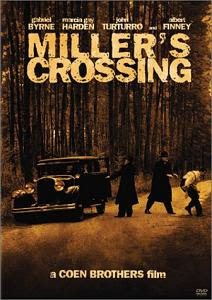
Miller's Crossing (1990): One of the Coen Brothers' Best Films

Miller's Crossing
I am not a huge fan of Joel and Ethan Coen's work. I find the majority of their films start out really great and intriguing. But what most often happens is at some point after the middle of the movie, they begin to lose momentum and magnificence. It could be they raise the audience's expectations so high that towards the end they are not able to fulfil them. The feeling I usually get after seeing a film of the Coens is of somehow wasted potential. What I like about Miller's Crossing is that it almost does not suffer from the aforementioned problem. It is not perfect but it is a good movie and I would recommend it as one of the better experiences the Coen brothers' have offered until now.

As many other gangster films, Miller's Crossing is set in the Prohibition Era in the beginning of the 20th century. Tom Reagan (Gabriel Byrne) tries to keep the peace between his Irish boss Leo (Albert Finney) and another gang of Italian mobsters. Leo insists on protecting Bernie Bernbaum (John Turturro) after the latter cheats the Italians' boss Johnny Caspar (Jon Polito) cause he is in love with Bernie's sister Verna (Marcia Gay Harden). Tom knows this is wrong and will lead to a lot of trouble for the Irishman but Leo does not listen to him. To make the relationships even more complicated Tom and Verna have an affair too. Reagan has to make some important choices and there are other characters in the mix whose "ethics" is questionable.

Miller's Crossing offers an interesting and rather intricate story. The relationships between the characters are quite complicated as well and most of the time it's hard to understand what is the actual motivation behind their actions (especially in regard to Tom Reagan). The movie features plenty of double-crossing and divided loyalties. There is a lot of outwitting and the exact outcome is not obvious. In a way Miller's Crossing slightly resembles Akira Kurosawa's Yojimbo (and it is also influenced by Dashiell Hammett's novels The Glass Key and Red Harvest) but Tom Reagan is in pursuit of completely different goals compared to the protagonist in Yojimbo.

The movie is about criminal "ethics" and loyalty. The former is not amongst the virtues of the main character but there are a few ironic (and iconic) speeches about ethics delivered by Johnny Caspar who is skilfully played by Jon Polito. The police in the city is practically bought and controlled by the dominating gang independently which one it is. Episodes of violence and black humour are to be expected (it's the Coen brothers' movie after all). And as usual the presence of symbols is not overlooked either, e.g., look about for a hat.

The acting in Miller's Crossing is very good and the casting has been quite successful. Gabriel Byrne does a wonderful job portraying the smart, restrained, laconic and amoral Tom Reagan. He has his own agenda and we are wondering throughout the whole film whether he has a heart or not. Albert Finney is behind the scene most of the time but when he's in frame, he makes are memorable appearances. John Turturro is really annoying as Bernie and it is not difficult to see why somebody would want him dead. Marcia Gay Harden is decent in her performance of Verna in an otherwise entirely masculine movie.

While the ending of Miller's Crossing could not be to the taste of everyone, I think the film is of an almost steady quality in its whole continuity. The Coens have done a better job than usual and the camera work is at the elevated level one would expect from their movies. The film lacks the grandeur of The Godfather but it is a very solid gangster movie and a good choice if you are an admirer of the crime genre.

Monday, January 16, 2012

Murder on the Orient Express (1974): Agatha Christie's Mystery

Murder on the Orient Express
Sidney Lumet's Murder on the Orient Express is packed with great actors. It has a good and interesting (despite being a bit narrow) plot based on a book by the world famous Agatha Christie. The director is arguably one of the best directors that have ever lived. The costumes and all other details are carefully crafted. And pretty much everything seems to be perfect at first glance. Then it's quite strange that although plenty of people like this movie, there are many that nearly hate it. The main reason probably lies in Albert Finney's representation of detective Hercule Poirot who creates a distinguishable character which is easy to be loved but equally easy to be hated too.

Multiple Oscar nominee (incl. for his role in Murder on the Orient Express) Albert Finney presents a really notable Hercule Poirot. He is intelligent but arrogant. He does not show sympathy for everybody. He could be gentle and charming with ladies yet impolite and restrained with particular men. He speaks with accent and sometimes it's hard to understand what he is saying. He manifests a sense of humour but he is also capable to be plain serious. He is a bit annoying at times and overly self-confident most of the time. All this translates to a character that could be simultaneously enjoyed and disliked depending on different people's perceptions.

While Finney gives quite a distinctive performance of Poirot, the rest of the all-star cast has not been misused either. Lauren Bacall as Mrs. Hubbard plays an important part constantly providing Poirot with clues and pieces of evidence. Martin Balsam enacts the train line director Bianchi who shows a lot of concern for the future of the Orient express after the murder has been committed on his train. Ingrid Bergman gets her 3rd Academy Award for a convincing (yet small) role of religious missionary in this movie. Jacqueline Bisset, Vanessa Redgrave, Wendy Hiller, Sean Connery, John Gielgud and Jean-Pierre Cassel are only some of the other renowned actors that make great portrayals in the film.

The movie exposes the life in 1935 with very typical shades. Almost all of the colorful and rich characters are very snobbish. The vehicles, the papers, the costumes are well selected and fits perfectly in the epoch. Sidney Lumet creates enough suspense although he has made tenser movies. The tight environment determined by the dimensions of a train car could call forth some parallels with Lumet's 12 Angry Men but this is quite a different film. In fact, the lack of space here probably furthers any theatrical resemblance that the acting could prompt eventually.

Another moment that could dissatisfy some moviegoers is the fact the ending revelations are not quite naturally coming out of the investigations presented in the film. Still, this is a common "feature" of most of the movies based on mystery books (a recent example could be Tinker Tailor Soldier Spy) so it's not such a specific flaw of Murder on the Orient Express. Despite its shortcomings this is a solid film. I can see where both its admirers and their opponents are drawing arguments from but it's a movie that is worth a look even just because of its (kind of a controversial) ending.